Back in the Saddle Again by Gene Autry
| Gene Autry | |
|---|---|
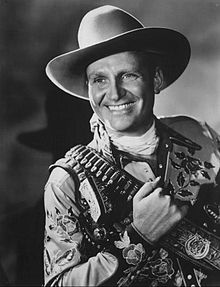 Autry in the 1940s | |
| Born | Orvon Grover Autry (1907-09-29)September 29, 1907 Tioga, Texas, U.S. |
| Died | October 2, 1998(1998-10-02) (aged 91) Los Angeles, California, U.S. |
| Burying place | Forest Lawn, Hollywood Hills Cemetery, U.S. |
| Other names | The Singing Cowboy, Gene Michaels |
| Occupation |
|
| Years active | 1925–1964 |
| Spouse(s) |
|
| Musical career | |
| Genres |
|
| Instruments |
|
| Labels |
|
| Website | geneautry |
Orvon Grover "Factor" Autry [i] (September 29, 1907 – October two, 1998),[2] nicknamed the Singing Cowboy, was an American singer, songwriter, role player, musician, rodeo performer, and baseball possessor who gained fame largely past singing in a crooning style on radio, in films, and on television for more than than three decades beginning in the early 1930s. Autry was the possessor of a television station, several radio stations in Southern California, and the Los Angeles/California Angels Major League Baseball team from 1961 to 1997.
From 1934 to 1953, Autry appeared in 93 films, and between 1950 and 1956 hosted The Gene Autry Show television series. During the 1930s and 1940s, he personified the straight-shooting hero—honest, brave, and truthful.[3] Autry was also one of the most important pioneering figures in the history of country music, considered the second major influential artist of the genre'southward development after Jimmie Rodgers.[3] His singing cowboy films were the kickoff vehicle to deport country music to a national audition.[3] In addition to his signature song, "Back in the Saddle Again" and his hit "At Post Call Today", Autry is still remembered for his Christmas songs, most peculiarly his biggest hit "Rudolph, the Red-Nosed Reindeer" as well as "Frosty the Snowman", "Hither Comes Santa Claus", and "Upward on the House Superlative".
Autry is a member of both the State Music Hall of Fame and the Nashville Songwriters Hall of Fame, and is the only person to be awarded stars in all v categories on the Hollywood Walk of Fame, for moving-picture show, television, music, radio, and live functioning.[4] The boondocks of Factor Autry, Oklahoma, was named in his honor, every bit was the Gene Autry precinct in Mesa, Arizona.[five]
Life and career [edit]
Early years [edit]
Orvon Grover Autry was born September 29, 1907, near Tioga in Grayson Canton in north Texas,[6] the grandson of a Methodist preacher. His parents, Delbert Autry and Elnora Ozment, moved in the 1920s to Ravia in Johnston Canton in southern Oklahoma. He worked on his begetter'south ranch while at schoolhouse. After leaving loftier school in 1925, Autry worked as a telegrapher[seven] for the St. Louis–San Francisco Railway. His talent at singing and playing guitar led to performing at local dances.
Singing career [edit]

While working every bit a telegraph operator in Chelsea, Oklahoma, Autry would sing and back-trail himself on the guitar to pass the lonely hours, specially when he had the midnight shift. This later got him fired. One nighttime, he was encouraged to sing professionally by a client, humorist Will Rogers, who had heard him singing.[viii] [9] [ten]
As shortly as he could save coin to travel, he went to New York. In the autumn of 1928, he auditioned for the Victor Talking Machine Company, shortly before buy by David Sarnoff's Radio Corporation of America (RCA). Co-ordinate to Nathaniel Shilkret,[11] director of Light Music for Victor at the time, Autry asked to speak to Shilkret after finding that he had been turned down. Shilkret explained to Autry that he was turned down not because of his phonation, only because Victor had simply made contracts with two similar singers. Autry left with a letter of the alphabet of introduction from Shilkret and the advice to sing on radio to proceeds experience and to come back in a year or 2. In 1928, Autry was singing on Tulsa radio station KVOO (now KTSB) as "Oklahoma'southward Yodeling Cowboy". The Victor athenaeum[12] show an October 9, 1929, entry stating that the vocal duet of Jimmie Long and Gene Autry with ii Hawaiian guitars, directed by L. L. Watson, recorded "My Dreaming of You" (Matrix 56761) and "My Alabama Abode" (Matrix 56762).
Autry signed a recording deal with Columbia Records in 1929. He worked in Chicago on the WLS-AM radio show National Barn Dance for four years, and with his ain bear witness, where he met singer-songwriter Smiley Burnette. In his early recording career, Autry covered diverse genres, including a labor song, "The Death of Mother Jones", in 1931.
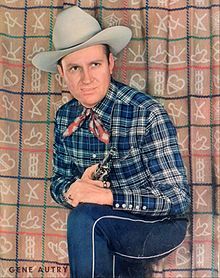
Autry also recorded many "hillbilly"-style records in 1930 and 1931 in New York City, which were certainly different in mode and content from his later recordings. These were much closer in style to the Prairie Ramblers or Dick Justice, and included the "Do Right, Daddy Blues" and "Black Bottom Dejection", both similar to "Deep Elem Dejection". These belatedly Prohibition-era songs deal with bootlegging, decadent police, and women whose occupation was certainly vice. These recordings are generally not heard today, simply are available on European import labels, such as JSP Records. His first hit was in 1932 with "That Silverish-Haired Daddy of Mine", a duet with fellow railroad man Jimmy Long that Autry and Long co-wrote.
Every bit Autry'southward moving-picture show career flourished, so did his record sales. His unofficial theme song became the Ray Whitley composition "Dorsum in the Saddle Once again".[13] Autry made 640 recordings, including more 300 songs written or co-written past himself. His records sold more than than 100 million copies and he has more than a dozen golden and platinum records, including the starting time record ever certified gold.
Today'southward listeners associate Gene Autry with Christmas songs, which are played perennially during each holiday flavour. These include.. "Santa Claus Is Comin' to Town", his own composition "Hither Comes Santa Claus", "Frosty the Snowman", and his biggest hitting, "Rudolph, the Red-Nosed Reindeer". He wrote "Here Comes Santa Claus" after being the One thousand Align of the 1946 Santa Claus Lane Parade (now the Hollywood Christmas Parade). He heard all of the spectators watching the parade saying, "Here comes Santa Claus!" virtually handing him the title for his song. He recorded his version of the song in 1947 and it became an instant classic.
In the tardily 1950s he began recording other artists, as the original owner of Claiming Records. The label's biggest hit was "Tequila" past The Champs in 1958, which started the stone and coil instrumental craze of the late 1950s and early 1960s. He sold the label before long later, but the maroon (later greenish) characterization has the "GA" in a shield above the label name.
Film career [edit]
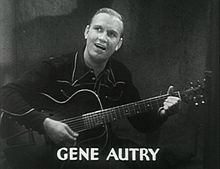
Autry and Burnette were discovered by film producer Nat Levine in 1934. Together, Autry and Burnette made their film debut for Mascot Pictures Corp. in In Old Santa Fe every bit part of a singing cowboy quartet; he was then given the starring role past Levine in 1935 in the 12-part serial The Phantom Empire. Soon thereafter, Mascot was absorbed past the newly formed Republic Pictures Corp. and Autry went along to make a farther 44 films upward to 1940. Most were low-budget Westerns in which he played under his own name, rode his equus caballus Champion, had Smiley Burnette as his regular sidekick, and had many opportunities to sing in each film. His films were tremendously successful, so much then that almost every other studio tried to compete past showcasing their ain singing cowboys. By 1940 Autry was Republic's biggest star, and his films became more costly and more than elaborate. They played first-run in large cities, unlike the usual "B" westerns that played in neighborhood theaters.

In the Picture show Herald Top X Money-Making Western Stars poll, Autry was listed every year from the commencement poll in 1936 to 1942 and 1946 to 1954 (he was serving in the AAF 1943–45), belongings offset place 1937 to 1942, and second place (later on Roy Rogers) 1947 to 1954, when the poll ceased.[14] He appeared in the like Boxoffice poll from 1936 to 1955, property beginning place from 1936 to 1942 and 2d place (later on Rogers) from 1943 to 1952.[15] While these two polls are really an indication simply of the popularity of series stars, Autry likewise appeared in the Top Ten Money Making Stars Poll of all films from 1940 to 1942,[16] His Cistron Autry Flight "A" Ranch Rodeo evidence debuted in 1940.[17]
Autry served in the U. South. Air Force during World War II. Part of his military service included his broadcast of a radio show for ane year; information technology involved music and truthful stories. Several decades agone on an early afternoon testify featuring Commonwealth westerns, one of Gene's sidekicks said that when Gene told Republic Pictures of his intentions to join the military during World War II, Commonwealth threatened to promote Roy Rogers as "King of the Cowboys" in Gene's absence, which it did. Republic reissued former Autry westerns during the state of war years, to continue his name before the public.
Autry's contract had been suspended for the duration of his military service, and he had tried to have it declared void after his discharge. The courts constitute in Republic's favor, and Autry returned to Republic subsequently the war. He finished out his contract with four more features, with Autry now publicized equally "Male monarch of the Singing Cowboys".
In 1947 Autry left Democracy for Columbia Pictures, which offered him his own production unit. He chose a new sidekick, Pat Buttram, recently returned from his World War II service. Buttram would co-star with Gene Autry in more than 40 films and in more than 100 episodes of Autry's television show. In 1951, Autry formed his ain company (Flight A Productions) to make westerns under his own control, and Columbia continued to distribute them through 1953.
Tune Ranch [edit]
Autry purchased the 110-acre Monogram Ranch in 1953, in Placerita Canyon near Newhall, California, in the northern San Gabriel Mountains foothills. He renamed it the Melody Ranch after his movie Melody Ranch. [18] Autry so sold 98 acres of the property, most of the original ranch. The Western town, adobes, and ranch cabin sets and open land for location shooting were retained as a flick ranch on 12 acres. Numerous "B" Westerns and Tv shows were shot there during Autry's buying, including the initial years of Gunsmoke with James Arness. A decade later on he purchased Melody Ranch, a brushfire swept through in Baronial 1962, destroying most of the original standing sets and dashing Autry's plans to turn it into a museum. However, the devastated mural did show useful for productions such as Combat!. A complete adobe ranch survived at the northeast department of the ranch.[19] [xx]
According to a published story past Autry, the fire acquired him to turn his attention to Griffith Park, where he would build his Museum of Western Heritage (now known equally the Autry Museum of the American West).
In 1990, after his favorite horse Champion Three, which lived in retirement at that place, died, Autry put the remaining 12-acre ranch up for sale. It was purchased by the Veluzat family in 1991 and rebuilt. It is now known as the Melody Ranch Movement Film Studio and Melody Ranch Studios on 22 acres.[21] The ranch has the Melody Ranch Museum open year-circular; and one weekend a yr, the entire ranch is open up to the public during the Cowboy Poetry and Music Festival, some other legacy of Autry's multiple talents.[22] [23]
Radio and television career [edit]
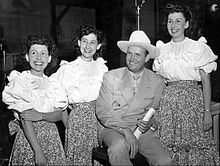
Cistron Autry with the Pinafores, who sang on his weekly radio evidence, 1948
From 1940 to 1956, Autry had a huge hit with a weekly show on CBS Radio, Gene Autry's Melody Ranch. His equus caballus, Champion, also had a Mutual radio series, The Adventures of Champion and a CBS-Boob tube series of the same name. In response to his many young radio listeners aspiring to emulate him, Autry created the Cowboy Code, or X Cowboy Commandments. These tenets promoting an ethical, moral, and patriotic lifestyle that appealed to youth organizations such equally the Boy Scouts, which developed similar doctrines. The Cowboy Code consisted of rules that were "a natural progression of Gene'due south philosophies going back to his kickoff Melody Ranch programs—and early on pictures."[24] According to the lawmaking:
- The Cowboy must never shoot first, hit a smaller human, or take unfair advantage.
- He must never become back on his discussion, or a trust confided in him.
- He must always tell the truth.
- He must be gentle with children, the elderly, and animals.
- He must non advocate or possess racially or religiously intolerant ideas.
- He must assist people in distress.
- He must be a expert worker.
- He must go on himself clean in thought, speech, action, and personal habits.
- He must respect women, parents, and his nation's laws.
- The Cowboy is a patriot.
Beginning in 1950, he produced and starred in his ain boob tube evidence on [CBS through his Flying A Productions studio. In the late 1950s, Autry also made several appearances on ABC-TV's Jubilee U.s.a..
War machine career [edit]
During Earth War 2, Autry enlisted in the United States Army in 1942, and became a tech sergeant in the United States Ground forces Air Forces. Belongings a private pilot certificate, he was determined to become a military pilot and earned his Service Pilot rating in June 1944, serving as a C-109 transport pilot with the rank of flight officer. Assigned to a unit of the Air Transport Command, he flew as part of the dangerous airlift performance over the Himalayas betwixt India and People's republic of china, nicknamed the Hump.[25] [26]
Rodeo [edit]
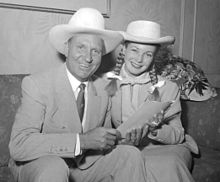
In 1942, at the acme of his screen popularity, Autry had a string of rodeo stock based in Ardmore, Oklahoma. A year later, he became a partner in the Earth Championship Rodeo Visitor, which furnished livestock for many of the country'southward major rodeos. In 1954, he acquired Montana'southward top bucking string from the estate of Leo J. Cremer, Sr., and put Canadian saddle bronc riding champion Harry Knight in charge of the operation. A merger with the World Title Rodeo Company in 1956 made Autry the sole owner. He moved the entire company to a 24,000-acre (97 km2) ranch near Fowler, Colorado, with Knight equally the working partner in the operation. For the next 12 years, they provided livestock for virtually of the major rodeos in Texas, Colorado, Montana, and Nebraska. When the company was sold in 1968, both men continued to exist active in rodeo. For his work as a livestock contractor, Autry was inducted into the Professional Rodeo Cowboys Association'southward ProRodeo Hall of Fame in 1979.[28] Autry received several honors for his contributions to rodeo.
Honors [edit]
- 1972 Hall of Great Western Performers of the National Cowboy & Western Heritage Museum[29]
- 1979 ProRodeo Hall of Fame[28]
- 1980 Hall of Bang-up Westerners of the National Cowboy Hall of Fame and Western Heritage Middle[30]
- 1988 Texas Trail of Fame[31]
- 2013 Texas Rodeo Cowboy Hall of Fame[32]
Cistron Autry comics [edit]
Gene Autry was oftentimes portrayed in the comics, primarily during the heyday of Western-themed comics, the 1940s and 1950s.
The Register and Tribune Syndicate comic strip Gene Autry Rides by Till Goodan was the first entry, lasting from 1940 to 1941. From 1941 to 1943, Autry was the field of study of a comic book initially published by Fawcett Comics and then picked upward by Dell Comics that ran 12 problems. Dell and so published 101 issues of Factor Autry Comics from 1946 to 1955. That title was changed to Gene Autry and Champion, and ran an additional 20 issues from 1955 to 1959, making it the longest-running (by number of issues) cowboy role player comic book.
Meanwhile, Autry was the discipline of an "Air-Western-Adventure Strip" comic strip syndicated past Full general Features from 1952 to 1955. The strip was produced in clan with Whitman Publishing.[33]
The Mexican publisher Editorial Novaro released 423 issues of Gene Autry comics from 1954 to 1984.
Toys [edit]
In 1937, Kenton Hardware Company began producing Gene Autry bandage-iron cap guns as a part of its line of fe toys. The toy was commission by Kenton vice-president Willard Bixler, who had conceptualized an atomic number 26 cap revolver modeled later the pearl-handled gun used by Gene Autry. The cap pistols were extremely popular and by 1939, 2 million units of the toy had been sold in the United States and away.[34]
Baseball [edit]

In the 1950s, Autry had been a minority owner of the minor-league Hollywood Stars. In 1960, when Major League Baseball announced plans to add an expansion team in Los Angeles, Autry—who had one time declined an opportunity to play in the pocket-size leagues—expressed an involvement in acquiring the radio broadcast rights to the team's games. Baseball game executives were so impressed by his arroyo that he was persuaded to become the possessor of the franchise rather than simply its broadcast partner. The squad, initially chosen the Los Angeles Angels upon its 1961 debut, moved to suburban Anaheim in 1966, and was renamed the California Angels, and so the Anaheim Angels from 1997 until 2005, when it became the Los Angeles Angels of Anaheim. Autry served as vice president of the American League from 1983 until his death. In 1995, he sold a quarter share of the team to the Walt Disney Company and a decision-making interest the post-obit yr, with the remaining share to be transferred after his death. Earlier, in 1982, he sold Los Angeles tv set station KTLA for $245 million.[ citation needed ] He also sold several radio stations he owned, including KSFO in San Francisco, KMPC in Los Angeles, KOGO in San Diego, and other stations in the Golden Due west radio network.
The number 26 was retired past the Angels in Autry'due south laurels. The chosen number reflected that baseball's rosters (at the time) had 25 men, then Autry's unflagging back up for his team fabricated him the "26th man" (run across also the 12th human, a similar concept in football). When the Angels finally won their beginning (and to date, only) Earth Serial championship in 2002, star outfielder Tim Salmon held Autry'due south cowboy hat aloft during the on-field celebration, and the public address system played his hit song, "Dorsum in the Saddle Again."
Hotels [edit]
He invested in property, owning past 1964 the Mark Hopkins Hotel in San Francisco; the Hotel Continental in Hollywood; the Sahara Inn, a $12-million motel well-nigh Chicago; plus belongings in Palm Springs.[35]
Retirement [edit]
Autry retired from show business in 1964, having made almost 100 films upwards to 1955 and over 600 records. He was elected to the Country Music Hall of Fame in 1969 and to the Nashville Songwriters Hall of Fame[36] in 1970. Later retiring, he invested widely in existent estate, radio, and television. He also invested in ownership of the KOOL-TV CBS-affiliate (now Fox affiliate KSAZ-Telly) in Phoenix, Arizona, which created local shows such as the weekly bilingual children's evidence Niños Contentos.
Republic Pictures, its finances failing, had shut down product in 1957. By the late 1960s Republic was barely operational, managing merely its motion-picture show library. Factor Autry, correctly assessing the company'due south cash-poor situation, made a greenbacks offer for the rights and negatives to his Republic films. The company accepted Autry's terms, and Autry now controlled the film materials for dwelling-moving-picture show reprints and home-video tapes and discs.
Death [edit]

Grave of Gene Autry, at Forest Lawn Hollywood Hills.
Cistron Autry died of lymphoma on Oct two, 1998, 3 days after his 91st altogether at his domicile in Studio Metropolis, California. He was buried at the Forest Lawn, Hollywood Hills Cemetery in Los Angeles. His epitaph read, "America'due south Favorite Cowboy ... American Hero, Philanthropist, Patriot and Veteran, Movie Star, Singer, Composer, Baseball Fan and Possessor, 33rd Caste Bricklayer, Media Entrepreneur, Loving Hubby, Gentleman".[37]
Personal life [edit]
In 1932, Autry married Ina Mae Spivey, the niece of Jimmy Long. During this marriage he had a sustained affair with Gail Davis, the actress who played Annie Oakley in the television series of the same name that Autry produced.[38] Afterward Spivey died in 1980, he married Jacqueline Ellam, who had been his banker, in 1981. He had no children by either spousal relationship.
While Autry was quiet most his political views during his life, his voting records listed him as a registered Republican, and he supported the Civil Rights Movement.[39]
Autry was raised into Freemasonry in 1927 at Catoosa Social club No. 185, Catoosa Oklahoma. He after became a 33rd degree Scottish Rite Mason, as recorded on his headstone.[40]
Legacy [edit]

Display of Gene Autry memorabilia at the Autry National Center, including his original Martin D-45 guitar, the first one fabricated
On November 16, 1941, the boondocks of Berwyn, Oklahoma, north of Ardmore, was renamed Gene Autry in his honor.[41] Though Autry was born in Tioga, Texas, his family moved to Oklahoma while he was an infant. He was raised in the southern Oklahoma towns of Achille and Ravia. Autry had also worked as a telegraph operator near Berwyn.[42] In 1939, he bought the one,200-acre (4.nine km2) Flying A Ranch on the west edge of Berwyn, and the town decided to accolade him past changing its proper noun. Approximately 35,000 people attended the ceremonies broadcast live from the site on Autry'south Melody Ranch radio show. Expectations that Autry would make his permanent domicile on the ranch were heightened when Autry's house in California burned down simply 8 days earlier the name change ceremony, simply dashed three weeks later with the attack on Pearl Harbor.[42] Autry joined the military in 1942 and sold the ranch afterwards the state of war.[42]
In 1972, he was inducted into the Hall of Not bad Western Performers at the National Cowboy Hall of Fame and Western Heritage Heart in Oklahoma City, Oklahoma. Autry was a life member of the Benevolent and Protective Order of Elks, Burbank Lodge No. 1497. His 1976 autobiography, co-written by Mickey Herskowitz, was titled Back in the Saddle Over again subsequently his 1939 striking and signature tune. He is too featured year subsequently year, on radio and "shopping mall music" at the holiday season, by his recording of "Rudolph, the Red-Nosed Reindeer." "Rudolph" became the get-go No. ane hit of the 1950s.[ commendation needed ] In 2003, he was ranked No. 38 in CMT's list of the forty Greatest Men of Country Music.
In 1977, Autry was awarded the American Patriots Medal by Freedoms Foundation of Valley Forge, Pennsylvania.[43]
Johnny Cash recorded a song in 1978 nearly Autry called "Who is Gene Autry?" Cash also got Autry to sign his famous black Martin D-35 guitar, which he plays in the video of "Hurt".[44]
In 1983, Autry received the Golden Plate Award of the American Academy of Achievement.[45]
Autry was inducted into the Oklahoma Hall of Fame in 1991.[41]
When the Anaheim Angels won their kickoff World Serial in 2002, much of the title was dedicated to him. The interchange of Interstate 5 and State Route 134, near the Autry National Centre in Los Angeles, is signed as the "Gene Autry Memorial Interchange." There is also a street named afterwards Autry in Anaheim, California called Gene Autry Fashion, and there is a street in Palm Springs, California named Gene Autry Trail.
Autry was inducted into the National Radio Hall of Fame in 2003. In 2004, Starz joined forces with the Autry estate to restore all of his films, which have been shown on Starz's Encore Westerns channel on premium television on a regular basis to date since.
In 2007, he became a charter fellow member of the Gennett Records Walk of Fame in Richmond, Indiana.[ citation needed ]
In May 2019, Warner Chappell Music acquired the Factor Autry Music Group, a music publisher comprising four smaller publishers, 1,500 compositions (including "Back in the Saddle Again", "Here Comes Santa Claus", "Simply Walkin' in the Rain", and "You Belong To Me"), and several of Autry's master recordings.[46]
Statues [edit]
California [edit]
- (1988) Dorsum in the Saddle Again by David Spellerberg (semi-public statue: Autry and his movie horse "Champion"); outside courtyard, Autry Museum of the American West, Los Angeles, California
- (1998) Gene Autry Statue by De L'Esprie (semi-public statue: Autry with lid in hand); exterior courtyard inside gate 2, Angel Stadium/Edison International Field of Anaheim, Anaheim, California
- (2009) Cistron Autry, America's Favorite Singing Cowboy past De Fifty'Esprie (public statue: Autry seated, with guitar); Palm Springs, California
Hollywood Walk of Fame [edit]
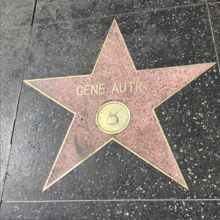
Gene Autry'southward Television set Star on the Hollywood Walk of Fame
Autry is the just person to have 5 stars on the Hollywood Walk of Fame, one in each of the five categories defined by the Hollywood Bedroom of Commerce.[47] All of Autry'due south stars are located along Hollywood Boulevard: Recording at 6384, Radio at 6520, Movement pictures at 6644, Television at 6667, and Alive theatre at 7000 Hollywood Boulevard. His first four stars were placed during the initial inductions of 1960 while the final ane was placed in 1987, in the boosted category named "Live theatre"—later renamed "Live performance"—introduced in 1984.[48] [49]
Museum of the American West [edit]
The Autry Museum of the American West in Los Angeles' Griffith Park was founded in 1988 as the Gene Autry Western Heritage Museum featuring much of Autry'due south personal drove of Western fine art and memorabilia as well as collections of his friends and other Western picture show stars. Since 2004, the museum is partnered with the Southwest Museum of the American Indian and is divided into two locations, eight miles apart from each other.
Discography [edit]
Albums [edit]
| Year | Album | U.s.a. Country | Characterization |
|---|---|---|---|
| 1976 | South of the Border, All American Cowboy | 42 | Democracy |
| Cowboy Hall of Fame | 44 |
Singles [edit]
1930s [edit]
| Year | Single |
|---|---|
| 1932 | "That Silverish-Haired Daddy of Mine" (west/ Jimmy Long) [l] |
| 1933 | "Yellow Rose Of Texas"[50] |
| "Cowboy's Heaven"[50] | |
| 1934 | "The Last Round-Upward"[50] |
| 1935 | "Tumbling Tumbleweeds"[51] |
| 1936 | "You lot're the Merely Star in My Blue Heaven"[52] |
| "Mexicali Rose"[52] | |
| 1938 | "Take Me Back to My Boots and Saddle"[53] |
| "Gold Mine in the Sky" | |
| 1939 | "Paradise in the Moonlight"[54] |
| "Dorsum in the Saddle Once again"[55] | |
| "South of the Border (Down Mexico Way)"[55] |
1940s [edit]
| Year | Single | Nautical chart positions | |||||||
|---|---|---|---|---|---|---|---|---|---|
| US Country | U.s.a. | ||||||||
| 1940 | "I'm Beginning To Intendance"[56] | i | — | ||||||
| "The Merry-Go-Roundup"[56] | 2 | — | |||||||
| "Cheerio Niggling Darlin' Goodbye"[57] | 2 | 276 | |||||||
| "Mary Dearest"[58] | 4 | — | |||||||
| "Were You lot Sincere"[59] | 1 | — | |||||||
| "Broomstick Buckaroo"[lx] | 3 | — | |||||||
| "Blueberry Colina" | — | — | |||||||
| 1941 | "You lot Are My Sunshine"[61] [62] [63] | 1 | 260 | ||||||
| "Be Honest With Me"[61] [63] | one | 259 | |||||||
| "You Waited Too Long"[63] | 2 | — | |||||||
| "It Makes No Deviation Now"[63] | 6 | — | |||||||
| "Solitary River"[64] | 9 | — | |||||||
| 1942 | "Tweedle-O-Twill"[65] | one | — | ||||||
| "Deep in the Heart of Texas"[65] | 1 | — | |||||||
| 1943 | "It Makes No Difference Now"[63] | iii | — | ||||||
| "I Hang My Caput and Cry"[65] | 4 | — | |||||||
| "We've Come A Long Manner Together"[65] | ten | — | |||||||
| 1944 | "I'm Thinking Tonight of My Blue Optics"[65] | 3 | — | ||||||
| 1945 | "At Mail Call Today"[65] | i | — | ||||||
| "I'll Be Dorsum"[65] | 7 | — | |||||||
| "Gonna Build a Big Fence Around Texas"[65] | 2 | — | |||||||
| "Don't Debate Me In"[65] | 4 | — | |||||||
| "Don't Hang Effectually Me Anymore"[66] | iv | — | |||||||
| "Don't Live a Lie"[66] | 4 | — | |||||||
| "I Want to Be Certain"[66] | 4 | — | |||||||
| 1946 | "Silverish Spurs (On the Golden Stairs)"[66] | 4 | — | ||||||
| "I Wish I Had Never Met Sunshine"[66] | 3 | — | |||||||
| "Y'all Only Desire Me When You're Lone"[66] | seven | — | |||||||
| "Wave to Me, My Lady"[66] | 4 | — | |||||||
| "Have I Told You Lately that I Love You?"[66] | three | — | |||||||
| "Someday (You'll Want Me to Want Yous)"[66] | 4 | — | |||||||
| 1947 | "Home On The Range"/"Red River Valley"[66] | — | — | ||||||
| "You're Not My Darlin' Anymore"[66] | 3 | — | |||||||
| 1948 | "Hither Comes Santa Claus (Downward Santa Claus Lane)"[66] | v | 8 | ||||||
| "Buttons and Bows"[66] | 6 | 17 | |||||||
| "Hither Comes Santa Claus (Right Down Santa Claus Lane)"[66] | 4 | 8 | |||||||
| 1949 | "Ghost Riders in the Sky"[67] | — | — | ||||||
| "Rudolph, the Cerise-Nosed Reindeer" (due west/ The Pinafores) [68] | 1 | i | |||||||
| "Here Comes Santa Claus (Correct Down Santa Claus Lane)"[66] | 8 | 24 | |||||||
| "—" denotes releases that did not chart | |||||||||
1950s [edit]
| Year | Single | Chart positions | |||||||
|---|---|---|---|---|---|---|---|---|---|
| US Country | Usa | ||||||||
| 1950 | "Peter Cottontail"[68] | 3 | five | ||||||
| "Frosty the Snow Man" (w/ The Cass County Boys) [68] | 4 | 7 | |||||||
| "Rudolph, the Red-Nosed Reindeer" (w/ The Pinafores) [68] | 5 | three | |||||||
| 1951 | "Erstwhile Soldiers Never Die" | 9 | — | ||||||
| 1952 | "Upward on the Housetop" | — | — | ||||||
| 1957 | "Nobody's Darlin' but Mine" | — | — | ||||||
| "Rudolph, the Red-Nosed Reindeer" (re-entry) [68] | — | 70 | |||||||
| "—" denotes releases that did not nautical chart | |||||||||
1990s [edit]
| Twelvemonth | Single | Nautical chart positions | |||||||
|---|---|---|---|---|---|---|---|---|---|
| US Country | US AC | ||||||||
| 1998 | "Rudolph, the Red-Nosed Reindeer" (re-entry) | 55 | — | ||||||
| 1999 | "Rudolph, the Red-Nosed Reindeer" (re-entry) | 60 | 24 | ||||||
| "—" denotes releases that did not chart | |||||||||
2010s [edit]
| Year | Unmarried | Chart positions |
|---|---|---|
| US | ||
| 2018 | "Rudolph, the Blood-red-Nosed Reindeer" (re-entry) | 16[69] |
| "Here Comes Santa Claus (Downward Santa Claus Lane)" (re-entry) | 28[69] | |
| 2019 | "Rudolph, the Scarlet-Nosed Reindeer" (re-entry) | 22[seventy] |
| "Here Comes Santa Claus (Downwardly Santa Claus Lane)" (re-entry) | 32[seventy] |
2020s [edit]
| Year | Single | Chart positions |
|---|---|---|
| US | ||
| 2020 | "Rudolph, the Red-Nosed Reindeer" (re-entry) | 16[71] |
| "Here Comes Santa Claus (Downwardly Santa Claus Lane)" (re-entry) | 26[71] | |
| 2021 | "Rudolph, the Red-Nosed Reindeer" (re-entry) | xix[72] |
Vacation 100 chart entries [edit]
Since many radio stations in the US prefer a format change to Christmas music each December, many vacation hits take an annual spike in popularity during the terminal few weeks of the year and are retired in one case the season is over.[73] In December 2011, Billboard began a Holiday Songs chart with 50 positions that monitors the terminal v weeks of each year to "rank the top holiday hits of all eras using the same methodology as the Hot 100, blending streaming, airplay, and sales data",[74] and in 2013, the number of positions on the chart was doubled, resulting in the Holiday 100.[75] A few Autry recordings take made appearances on the Holiday 100 and are noted below according to the holiday flavour in which they charted there.
| Title | Holiday season height chart positions | ||||||||||
|---|---|---|---|---|---|---|---|---|---|---|---|
| 2011 | 2012 | 2013 | 2014 | 2015 | 2016 | 2017 | 2018 | 2019 | 2020 | 2021 | |
| "Rudolph the Red-Nosed Reindeer" | 14[76] | 14[77] | 11[78] | 11[79] | 8[lxxx] | 10[81] | ten[82] | 7[83] | 10[84] | fourteen[85] | xiii[86] |
| "Here Comes Santa Claus (Down Santa Claus Lane)" | 45[87] | 34[88] | 43[89] | 48[ninety] | 27[91] | 37[92] | eighteen[93] | x[83] | 12[94] | 12[95] | 25[96] |
| "Up on the Housetop" | — | — | eighty[97] | — | — | 94[92] | 80[98] | 72[99] | 94[94] | 91[95] | 74[96] |
| "Frosty the Snowman" | — | — | — | — | 100[91] | 90[92] | — | — | — | — | — |
Filmography [edit]
From 1934 to 1953, Autry appeared in 93 films.[100] [Annotation ane] From 1950 to 1955, he also appeared in 91 episodes of The Cistron Autry Show television serial.[101] [102] As of 2014[update], a large number of these films and telly episodes remain available via the Factor Autry Foundation on the Western Channel (a cable telly station), the latter having collaborated with the Foundation to restore the Republic titles, which had been cut to a uniform 54 minutes for television release in the 1950s, to full length and to provide clean negative-based source prints for all the titles in the 1990s.
Run into as well [edit]
- Autry National Center of the American West
- Tune Movie Ranch
- Hollywood Christmas Parade
- Gene Autry, Oklahoma
- Listing of best-selling music artists
- List of Freemasons
Farther reading [edit]
- Michael Duchemin (September 22, 2016). New Deal Cowboy: Gene Autry and Public Diplomacy. Academy of Oklahoma Printing. ISBN9780806153926. OCLC 959274480.
- Sandi Hemmerlein (September 6, 2019). "Beyond Gene Autry: The Making of the Singing Cowboy Myth". PBS.
Notes [edit]
- ^ Autry's first 3 films were produced by Mascot Pictures. His next 57 films, from Tumbling Tumbleweeds (1935) through Robin Hood of Texas (1947), were produced past Republic Pictures. His terminal 33 films, from The Last Circular-up (1947) through Last of the Pony Riders (1953), were produced by Columbia Pictures.[100]
References [edit]
- ^ George-Warren 2007, p. 13
- ^ "'Singing Cowboy' Cistron Autry dead at 91". CNN. Oct 2, 1998. Retrieved July 4, 2019.
- ^ a b c Cusic 2010, p. one
- ^ "Near Hollywood Star Walk". Los Angeles Times . Retrieved May 27, 2012.
- ^ Scriba, Jay (Oct 15, 1970). "From Sleepy Eye to Chicken Bristle, U.s.a.". The Milwaukee Journal . Retrieved Apr 22, 2015.
- ^ "Gene Autry". Texas Archive of the Moving Epitome . Retrieved September 17, 2021.
- ^ "Nashville Songwriters Hall of Fame". nashvillesongwritersfoundation.com . Retrieved September 17, 2021.
- ^ DeLong, Thomas A. (1980). The Mighty Music Box: The Golden Historic period of Musical Radio. Los Angeles: Amber Crest Books. ISBN978-0-86533-000-9.
- ^ Smith, Ardis (Nov 13, 1940). "Autry, First Cowboy of Land, Makes $300,000 Annually". Buffalo New York News.
- ^ Dabney, Eric. "Orvon Gene Autry (1907–1998)". Encyclopedia of Oklahoma History & Civilization. Archived from the original on Nov 3, 2012. Retrieved May 27, 2012.
- ^ Shilkret, Nathaniel, ed. Niel Beat and Barbara Shilkret, Nathaniel Shilkret: Sixty Years in the Music Business organization, Scarecrow Printing, Lanham, Maryland, 2005. ISBN 0-8108-5128-8.
- ^ Victor Recording Book, p. 7247. (This is a page from Victor'southward daily log of recordings.)
- ^ Gilliland, John (1969). "Show 9 – Tennessee Firebird: American country music before and later on Elvis. [Role i]" (audio). Popular Chronicles. University of North Texas Libraries.
- ^ Phil Hardy The Encyclopedia of Western Movies, London, Octopus, 1985, ISBN 0-8300-0405-X
- ^ "Quigley Publishing Elevation 10 MoneyMakers Poll". B Westerns. Retrieved May 27, 2012.
- ^ "Top 10 Money Making Stars". Quigley Publishing. Archived from the original on December 21, 2014. Retrieved May 27, 2012.
- ^ "Cistron Autry". Net Movie Database . Retrieved May 27, 2012.
- ^ "Flick Magic in Placerita Canyon". Scvhistory.com . Retrieved May xv, 2010.
- ^ "Placeritos Ranch/Monogram Ranch/Melody Ranch". Movielocationsplus.com . Retrieved December 24, 2017.
- ^ Autry, Gene. "Memories of the identify I called Melody Ranch". Scvhistory.com . Retrieved February two, 2008.
- ^ "Tune Ranch Move Picture Studio". Melodyranchstudio.com . Retrieved May 15, 2010.
- ^ "Museum". Melodyranchstudio.com . Retrieved May 15, 2010.
- ^ "Archived copy". world wide web.cowboyfestival.org. Archived from the original on December iv, 2004. Retrieved January 17, 2022.
{{cite web}}: CS1 maint: archived copy as title (link) - ^ George-Warren 2007, p. 256
- ^ "GeneAutry.com: Gene Autry: Flight Officer Cistron Autry". Geneautry.com.
- ^ "A Plane-Crazy America". AOPA Pilot. May 2014. p. 79.
- ^ "Canadian National Exhibition Grandstand Performers 1948-1994", See the performers for 1956. Retrieved 25 November 2017
- ^ a b "Gene Autry – Pro Rodeo Hall of Fame". Pro Rodeo Hall of Fame . Retrieved April 22, 2017.
- ^ "Great Western Performers". National Cowboy & Western Heritage Museum . Retrieved May 17, 2017.
- ^ "Hall of Great Westerners". National Cowboy & Western Heritage Museum . Retrieved May 17, 2017.
- ^ "Gene Autry". Western Heritage from the Texas Trail of Fame. May 25, 2013. Retrieved May 17, 2017.
- ^ "Texas Rodeo Cowboy Hall of Fame: Past Inductees". Texasrodeocowboy.com . Retrieved May 17, 2017.
- ^ Knoll, Erwin. "New Autry Strip Has Cowboys, Spies, Space," Editor & Publisher (July 26, 1952). Archived at Stripper'due south Guide.
- ^ "GeneAutry.com: Kenton, Ohio". Geneautry.com . Retrieved Dec 31, 2020.
- ^ Green, Abel (January eight, 1964). "A Year of Tragedy & Trifles". Variety. p. three.
- ^ "Gene Autry". Nashvillesongwritersfoundation.com. Nashville Songwriters Hall of Fame. Retrieved December 24, 2017.
- ^ "America's Favorite Cowboy". Forestlawn.com. October 3, 2019. Retrieved August four, 2021.
- ^ Rugh, Susan Sessions (2008). Are We There Nevertheless?: The Golden Age of American Family Vacations. University Press of Kansas. p. 97. ISBN978-0-7006-1588-9.
- ^ "Hollywoods Secret Republicans of the 1950s". Gizmodo.com. January 17, 2017.
- ^ Autry, Factor. "K Lodge of BC and the Yukon". Freemasonry.bcy.ca . Retrieved July 28, 2012.
- ^ a b "Oklahomaheritage.com". 77.oklahomaheritage.com.
- ^ a b c "Back in Saddle Again; Permit's revisit Oklahoma town (Gene Autry) with famous cowboy's name". Jimmie Tramel, Tulsa World, September 16, 2019. Retrieved September 16, 2019.
- ^ "66th Legislature, Resolutions – Congratulatory and Honorary". Lrl.state.tx.us . Retrieved October 11, 2013.
- ^ "Johnny Greenbacks – Who's Gene Autry?" – via genius.com.
- ^ "Golden Plate Awardees of the American Academy of Achievement". Achievement.org. American University of Achievement.
- ^ Eggertsen, Chris (May thirty, 2019). "Warner Chappell Acquires Cistron Autry Music Group". Billboard.
- ^ "The Official Website for Gene Autry – Hollywood Walk of Fame". geneautry.com. Cistron Autry Entertainment. Retrieved November eight, 2017.
- ^ "Hollywood Walk of Fame – Factor Autry". Walkoffame.com. Hollywood Chamber of Commerce. Retrieved Nov 8, 2017.
- ^ "Hollywood Walk of Fame – History of the Walk of Fame". Walkoffame.com. Hollywood Chamber of Commerce. Retrieved November viii, 2017.
- ^ a b c d "PERFECT 78rpm numerical listing discography (12500 - 13000)". www.78discography.com . Retrieved February 4, 2022.
- ^ "Vocalion 78rpm numerical listing discography: 3000 - 3500". www.78discography.com . Retrieved February four, 2022.
- ^ a b "MELOTONE 1936 78rpm numerical list discography". www.78discography.com . Retrieved March 2, 2022.
- ^ "Vocalion 78rpm numerical list discography: 4000 - 4500". www.78discography.com . Retrieved February iv, 2022.
- ^ "Hillbilly Recordings – Calendar month Ending May 27, 1939" (PDF). The Billboard. Cincinnati, Ohio. May 27, 1939. p. 82. Retrieved July 17, 2021.
- ^ a b "Vocalion 78rpm numerical listing discography - 5000 series (main sequence)". www.78discography.com . Retrieved February 4, 2022.
- ^ a b "Hillbilly Recordings – Month Ending January 27, 1940" (PDF). The Billboard. Cincinnati, Ohio. Jan 27, 1940. p. 70. Retrieved July 17, 2021.
- ^ "Hillbilly Recordings – Month Ending June 29, 1940" (PDF). The Billboard. Cincinnati, Ohio. June 29, 1940. p. 102. Retrieved July 17, 2021.
- ^ "Hillbilly Recordings – Month Ending August 31, 1940" (PDF). The Billboard. Cincinnati, Ohio. August 31, 1940. p. 112. Retrieved July 17, 2021.
- ^ "Hillbilly Recordings – Month Catastrophe September 28, 1940" (PDF). The Billboard. Cincinnati, Ohio. September 28, 1940. p. 70. Retrieved July 17, 2021.
- ^ "Hillbilly Recordings – Calendar month Catastrophe December 28, 1940" (PDF). The Billboard. Cincinnati, Ohio. December 28, 1940. p. 132. Retrieved July 17, 2021.
- ^ a b "Hillbilly Recordings – Month Ending August thirty, 1941" (PDF). The Billboard. Cincinnati, Ohio. August thirty, 1941. p. 104. Retrieved July 17, 2021.
- ^ "Second Mitt Songs – Vocal: Y'all Are My Sunshine – Paul Rice". Secondhandsongs.com . Retrieved July 27, 2010.
- ^ a b c d due east "OKeh (by CBS) 78rpm numerical listing discography: 6000 - 6500". www.78discography.com . Retrieved February iv, 2022.
- ^ "The Online Discographical Project – Okeh (CBS) 6500–6747 (1941–45)". 78discography.com . Retrieved February 21, 2011.
- ^ a b c d east f g h i "OKeh (by CBS) 78rpm numerical listing discography: 6500 - 6747 (terminate of series)". www.78discography.com . Retrieved February four, 2022.
- ^ a b c d e f thou h i j g l yard n o "COLUMBIA 78rpm numerical listing discography: Country/Western serial 20000 - 20500". world wide web.78discography.com . Retrieved February 4, 2022.
- ^ "COLUMBIA 78rpm numerical listing discography: 20500 - 21000". www.78discography.com . Retrieved February 4, 2022.
- ^ a b c d eastward "COLUMBIA RECORDS: 78rpm numerical list discography 38500 - 39000". www.78discography.com . Retrieved February four, 2022.
- ^ a b "The Hot 100 (Week of January 5, 2019)". Billboard. January 5, 2019. Retrieved December 13, 2021.
- ^ a b "The Hot 100 (Week of January 4, 2020)". Billboard. January 4, 2020. Retrieved December xiii, 2021.
- ^ a b "The Hot 100 (Calendar week of January 2, 2021)". Billboard. January two, 2021. Retrieved December 13, 2021.
- ^ "The Hot 100 (Week of Jan 1, 2022)". Billboard. January 1, 2022. Retrieved December thirty, 2021.
- ^ Judkis, Maura (Dec 22, 2015). "Jingle bong stone: Why lots of radio stations get all-Christmas in December". Chicago Tribune . Retrieved Feb viii, 2019.
- ^ "Andy Williams Hits New High, The Ronettes 'Ride' Back After 52 Years & More Hot 100 Nautical chart Moves". Billboard.com . Retrieved Feb viii, 2019.
- ^ "Carey Brings Back 'Christmas'". Billboard. December 14, 2013. p. 115.
- ^ "Holiday 100: The week of December 17, 2011". billboard.com. Archived from the original on April 7, 2018. Retrieved March 9, 2019.
- ^ "Holiday 100: The calendar week of January 5, 2013". billboard.com. Archived from the original on April 7, 2018. Retrieved March 9, 2019.
- ^ "Holiday 100: The calendar week of December 28, 2013". billboard.com. Archived from the original on April seven, 2018. Retrieved March 9, 2019.
- ^ "Holiday 100: The week of January 3, 2015". billboard.com. Archived from the original on April 7, 2018. Retrieved March 9, 2019.
- ^ "Holiday 100: The week of December nineteen, 2015". billboard.com. Archived from the original on April 7, 2018. Retrieved March ix, 2019.
- ^ "Vacation 100: The week of December 31, 2016". billboard.com. Archived from the original on April 7, 2018. Retrieved March 9, 2019.
- ^ "Holiday 100: The calendar week of January 3, 2018". billboard.com. Archived from the original on April 7, 2018. Retrieved March 9, 2019.
- ^ a b "Holiday 100: The calendar week of December 22, 2018". billboard.com. Archived from the original on February 23, 2019. Retrieved March 9, 2019.
- ^ "Holiday 100: The calendar week of December 28, 2019". billboard.com. Archived from the original on August five, 2020. Retrieved January ane, 2021.
- ^ "Holiday 100: The calendar week of January 2, 2021". billboard.com. Archived from the original on Jan 4, 2021. Retrieved January 1, 2021.
- ^ "Vacation 100 (Week of Dec 25, 2021)". Billboard. Dec 25, 2021. Retrieved December 21, 2021.
- ^ "Vacation 100: The week of Dec 24, 2011". billboard.com. Archived from the original on Apr 7, 2018. Retrieved March 9, 2019.
- ^ "Holiday 100: The week of Dec 8, 2012". billboard.com. Archived from the original on Apr vii, 2018. Retrieved March nine, 2019.
- ^ "Holiday 100: The week of January 4, 2014". billboard.com. Archived from the original on April 7, 2018. Retrieved March 9, 2019.
- ^ "Holiday 100: The week of Dec 13, 2014". billboard.com. Archived from the original on Apr 7, 2018. Retrieved March 9, 2019.
- ^ a b "Holiday 100: The calendar week of December 12, 2015". billboard.com. Archived from the original on April 7, 2018. Retrieved March ix, 2019.
- ^ a b c "Holiday 100: The week of December ten, 2016". billboard.com. Archived from the original on Apr 7, 2018. Retrieved March nine, 2019.
- ^ "Holiday 100: The week of December 30, 2017". billboard.com. Archived from the original on April vii, 2018. Retrieved March nine, 2019.
- ^ a b "Holiday 100: The week of December 7, 2019". billboard.com. Archived from the original on August 18, 2021. Retrieved Jan 1, 2021.
- ^ a b "Holiday 100: The week of December 5, 2020". billboard.com. Archived from the original on January 3, 2021. Retrieved January one, 2021.
- ^ a b "Holiday 100 (Week of December 4, 2021)". Billboard. December iv, 2021. Retrieved December xiii, 2021.
- ^ "Holiday 100: The week of Dec 14, 2013". billboard.com. Archived from the original on Apr 7, 2018. Retrieved March 9, 2019.
- ^ "Holiday 100: The week of December 9, 2017". billboard.com. Archived from the original on April 7, 2018. Retrieved March nine, 2019.
- ^ "Holiday 100: The week of December eight, 2018". billboard.com. Archived from the original on February 23, 2019. Retrieved March 9, 2019.
- ^ a b Magers 2007, pp. 21–336
- ^ Magers 2007, pp. 342–344
- ^ George-Warren 2007, pp. 382–385
Sources [edit]
- Autry, Gene (1978). Back in the Saddle Once more . New York: Doubleday. ISBN978-0-385-03234-6.
- Cusic, Don (2010). Factor Autry: His Life and Career. Jefferson: McFarland. ISBN978-0-7864-5978-0.
- George-Warren, Holly (2007). Public Cowboy no. 1: The Life and Times of Cistron Autry . New York: Oxford Academy Printing. ISBN978-0-19-517746-6.
- Green, Douglas B. (2002). Singing in the Saddle: The History of the Singing Cowboy . Nashville: Vanderbilt University Press. ISBN978-0-8265-1412-7.
- Guyot-Smith, Jonathan (1998). Paul Kingsbury (ed.). The Encyclopedia of Land Music . New York: Oxford University Press. pp. 22–23. ISBN978-0-19-511671-7.
- Magers, Boyd (2007). Gene Autry Westerns. Madison, N Carolina: Empire Publishing, Inc. ISBN978-0-944019-49-8.
- Richliano, James (2002). Angels Nosotros Have Heard: The Christmas Song Stories. New York: Star of Bethlehem Books. pp. 154–219. ISBN0-9718810-0-6.
External links [edit]
- Official website
- Gene Autry at IMDb
- Gene Autry at AllMovie
- Factor Autry at the National Radio Hall of Fame
- Autry National Center
- Country Music Hall of Fame and Museum
- Melody Ranch Pic Studio Museum
- Discography of Gene Autry albums
- Zoot Radio, complimentary onetime fourth dimension radio show downloads of Gene Autry
Source: https://en.wikipedia.org/wiki/Gene_Autry

Post a Comment for "Back in the Saddle Again by Gene Autry"